
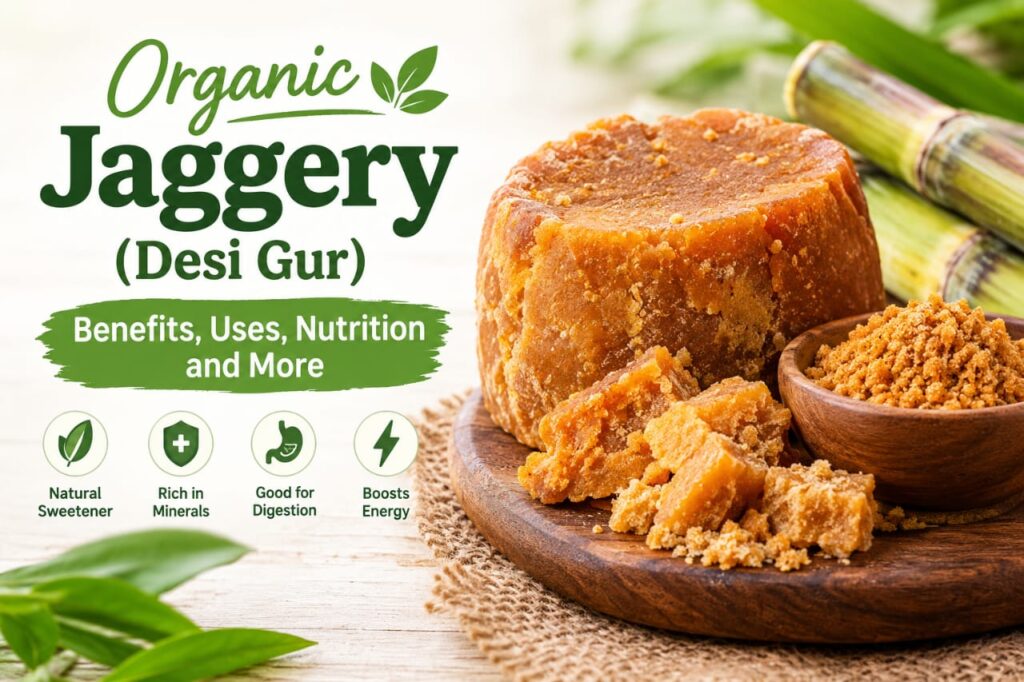
Jaggery, commonly known as Desi Gur, Desi Gud, or Gur, is a traditional sweetener made by concentrating sugarcane juice until it thickens and solidifies. Unlike refined white sugar, jaggery is not processed into uniform sugar crystals, so it retains some of the naturally occurring compounds and minerals present in sugarcane juice.
For people looking to replace refined sugar with a more traditional sweetener, organic jaggery can be a useful option. However, it is important to understand that jaggery is still primarily a source of sugar and should be consumed in moderation. Its value lies more in its traditional preparation, less-refined nature, distinctive flavour and versatility than in treating it as a health product.
FSSAI recognises Gur or Jaggery and Cane Jaggery or Cane Gur as food categories, with standards covering parameters such as moisture, sugars, ash and extraneous matter.
What Is Organic Jaggery and How Is It Made?
Organic jaggery is jaggery produced from sugarcane grown under certified organic production practices and processed according to applicable organic-food requirements. The exact certification and processing requirements depend on the applicable organic standard and certification system.
Traditional cane jaggery begins with freshly harvested sugarcane. The cane is crushed to extract the juice, which is then filtered and heated. As the juice boils, water evaporates and the liquid gradually becomes concentrated. It is then further cooked until it reaches the required consistency before being cooled and moulded into blocks, cakes or other forms.
Traditional Organic Jaggery-Making Flowchart
Organic Sugarcane
↓
Harvesting
↓
Cleaning & Sorting
↓
Sugarcane Crushing
↓
Fresh Cane Juice Extraction
↓
Juice Filtration
↓
Controlled Heating
↓
Removal of Foam & Impurities
↓
Concentration of Cane Juice
↓
Thick Jaggery Mass
↓
Cooling & Setting
↓
Moulding / Cutting / Powdering
↓
Quality Testing & Packaging
↓
Organic Jaggery / Desi Gur
The traditional process is relatively straightforward, but quality can vary significantly depending on the sugarcane, water quality, processing conditions, hygiene, clarification methods and storage.
FSSAI’s cane-jaggery framework describes cane gur as a product obtained by boiling or processing juice pressed from sugarcane. It also specifies analytical requirements and states that food-grade materials should be used where permitted for clarification.
What Are the Benefits of Organic Jaggery?
Organic jaggery offers several practical advantages as a traditional sweetener, although its benefits should not be overstated.
1. Less Refined Than White Sugar
The major difference is the processing method. Refined sugar is processed to produce highly purified sugar crystals, whereas traditional jaggery is produced by concentrating sugarcane juice.
Because jaggery undergoes less extensive refining, it can retain small quantities of minerals and other naturally occurring components from the cane juice. This does not mean jaggery should be treated as a major source of nutrients.
2. Provides Quick Energy
Jaggery contains a high proportion of sugars, which means it provides readily available energy. This is one reason it has traditionally been used in Indian households after meals, during physical activity and in various traditional preparations.
However, the body still treats the sugars in jaggery as sugars. Therefore, replacing white sugar with jaggery does not make unlimited sweetener consumption advisable.
3. Contains Some Minerals
Compared with highly refined sugar, jaggery may retain small amounts of minerals such as iron, calcium, magnesium and potassium, depending on its composition and processing.
The exact nutritional content can vary between products, so it is better to check the product’s nutrition information rather than assume that every jaggery has the same mineral content.
4. Distinctive Taste and Aroma
Organic jaggery has a deeper flavour than refined sugar. Depending on the variety and processing method, it can have caramel-like, earthy or mildly smoky notes.
This makes it particularly useful in traditional Indian recipes where the flavour of jaggery is part of the dish rather than simply a source of sweetness.
5. Useful in Traditional Recipes
Desi Gur can be used in:
- Tea and other beverages
- Laddoos and traditional sweets
- Kheer and desserts
- Chutneys and sauces
- Porridge
- Homemade energy snacks
- Indian festive preparations
- Jaggery-based beverages
- Baking and cooking
6. Convenient Alternative to Granulated Sugar
Jaggery blocks, powder and grated jaggery can be incorporated into recipes where a traditional sweetener is preferred. Powdered jaggery is particularly convenient because it dissolves more easily.
Important: Jaggery is not sugar-free. People managing their sugar intake should account for it as a source of added sugar.
Organic Jaggery Nutrition: What Does It Contain?
The nutritional composition of jaggery varies according to the raw material and manufacturing process. It is primarily a carbohydrate-rich sweetener, with sugars making up most of its composition.
| Nutritional aspect | Organic Jaggery |
| Main component | Sugars/carbohydrates |
| Primary source | Sugarcane juice |
| Protein | Present in small amounts |
| Fat | Generally very low |
| Minerals | Small amounts may be present |
| Fibre | Generally low |
| Calories | Energy-dense |
| Sweetness | High |
| Processing | Less refined than white sugar |
| Common forms | Block, cube, grated and powder |
FSSAI’s cane-jaggery standard includes parameters such as minimum sucrose and total sugars and limits for moisture, ash and extraneous matter, illustrating why the composition of a properly manufactured product is more specific than simply describing jaggery as “natural sugar.”
How Is Desi Gur Different From Regular Sugar?
The simplest difference is how they are processed.
White sugar is refined and crystallised to produce relatively pure sucrose crystals. Desi Gud is produced by concentrating sugarcane juice and allowing the concentrated mass to set.
| Feature | Organic Jaggery / Desi Gur | Refined White Sugar |
| Raw material | Usually sugarcane | Usually sugarcane or sugar beet |
| Form | Blocks, pieces or powder | Crystals |
| Processing | Concentrated and minimally refined | More extensively refined |
| Colour | Golden to dark brown | White |
| Flavour | Rich, earthy and caramel-like | Clean, neutral sweetness |
| Mineral content | May retain small amounts | Very little |
| Main component | Sugars | Mainly sucrose |
| Traditional use | Indian sweets, drinks and cooking | General sweetening and baking |
| Sugar-free? | No | No |
The key point is that jaggery is not a low-sugar food simply because it is less refined. Both products are concentrated sweeteners.
What Is Desi Gud and How Is It Traditionally Made?
Desi Gud is another common name for traditional jaggery. In different parts of India, terms such as Gur, Gud, Jaggery, Desi khand and Desi Gud may be used interchangeably, particularly when referring to traditional cane jaggery.
The traditional method begins with fresh sugarcane. The cane is crushed to obtain juice, which is filtered before being transferred to a large heating vessel. The juice is heated so that excess water evaporates. During heating, foam and impurities can be removed as part of the clarification process.
Once the juice becomes sufficiently concentrated, it develops a thick consistency. The hot jaggery mass is transferred for cooling and shaping. Depending on the producer, it may be formed into large blocks, smaller pieces, cubes or powder.
The result is the familiar golden-brown to dark-brown sweetener known as Desi Gur.
What Is the Difference Between Desi Gur and Jaggery?
In most everyday usage, Desi Gur and jaggery refer to the same basic product when both are made from sugarcane.
“Jaggery” is the widely used English term, while “Gur” or “Gud” is commonly used in India. “Desi Gur” generally emphasises the traditional Indian style of jaggery.
However, not every jaggery product is identical. Jaggery can differ in:
- Source of sugarcane
- Region of production
- Processing method
- Moisture content
- Colour
- Texture
- Sweetness
- Storage conditions
- Form of sale
- Quality controls
Jaggery can also be produced from sources other than sugarcane, such as certain palm varieties. Therefore, when buying organic sugarcane jaggery, checking the ingredient and product information is important.
Is Organic Jaggery a Better Alternative to Refined Sugar?
Organic jaggery can be a less-refined traditional alternative to refined sugar, particularly for consumers who prefer its flavour, texture and production style.
But “better” should not be interpreted as “healthy in unlimited quantities.”
Both jaggery and refined sugar are concentrated sources of sugar. Jaggery’s less-refined nature means it may retain small amounts of minerals and other components that are largely removed during sugar refining. At the same time, these nutrients are generally not present in quantities that make jaggery a substitute for a balanced diet.
A practical approach is to use jaggery in moderation and choose it when its taste, traditional character or less-refined processing aligns with your food preferences.
How to Choose Pure and Organic Jaggery?
Choosing good-quality jaggery starts with the label rather than relying only on colour.
Check the Ingredient List
For a simple cane-jaggery product, the ingredient information should clearly identify the product. Avoid assuming that every brown-coloured sweetener is automatically pure jaggery.
Look for Appropriate Organic Certification
If a product is marketed specifically as organic, check the applicable organic certification or conformity information on the packaging. FSSAI lists the Food Safety and Standards (Organic Foods) Regulations as part of India’s food regulatory framework.
Check the Packaging
Choose properly packaged products with clear information about:
- Manufacturer or seller
- Ingredients
- Net quantity
- Batch information
- Date information
- Storage instructions
- Applicable certification or licence details
Look at Texture and Appearance
Good jaggery can naturally vary from golden brown to deep brown. Colour alone cannot reliably prove purity.
A product that is excessively uniform, unusually bright or contains visible foreign matter deserves closer attention.
Consider Testing and Quality Controls
For commercial products, laboratory testing and controlled sourcing provide stronger evidence of quality than home-based colour or water tests.
FSSAI’s jaggery surveillance has identified quality and compliance issues in some market samples, including concerns around added colours and sulphite levels, highlighting why proper quality control and compliant manufacturing matter.
How to Identify Pure Desi Gur and Desi Gud?
There is no single reliable household test that can confirm every aspect of jaggery purity.
Some traditional checks involve examining colour, aroma, texture or how the jaggery behaves when dissolved in water. These may provide clues, but they cannot reliably establish organic certification, pesticide status, additive compliance or complete purity.
For a more dependable purchase, look for:
- Clear ingredient information
- Proper food-business and product labelling
- Organic certification where an organic claim is made
- Reputable sourcing
- Appropriate packaging
- Batch and traceability information
- Quality testing where applicable
A Simple Buying Flowchart
Want to Buy Organic Jaggery?
↓
Check Product Label
↓
Is Sugarcane Jaggery Clearly Identified?
↙ ↘
No Yes
↓ ↓
Choose Another Check Organic
Product Certification
↓
Check Ingredients
↓
Check Packaging & Dates
↓
Check Manufacturer Details
↓
Look for Quality Assurance
↓
Make Your Choice
How to Use Organic Jaggery
Organic jaggery can easily fit into everyday cooking. It can be grated from a block or used in powdered form depending on the recipe.
In Tea
Small amounts of jaggery can be added to tea for a deeper sweetness and caramel-like flavour. Allow the beverage to cool slightly if preferred before adding it, depending on the recipe and personal preference.
In Traditional Sweets
Jaggery works particularly well in laddoos, chikkis, kheer, halwa and other traditional Indian desserts.
In Breakfast Foods
Grated or powdered jaggery can be added to porridge, homemade granola or other breakfast preparations.
In Cooking
Jaggery is not limited to sweet dishes. Small quantities can balance flavours in chutneys, sauces, marinades and certain savoury Indian recipes.
As a Table Sweetener
Powdered jaggery can be used where a recipe calls for sugar, although the sweetness, moisture and flavour may differ, so the quantity may need adjustment.
Organic Jaggery: Traditional Sweetness With a Simpler Approach
Organic jaggery brings together a traditional food-making process and a familiar Indian ingredient that has been used for generations. From sugarcane juice extraction to concentration and moulding, its production is considerably different from the crystallisation and refining used for white sugar.
For consumers, the most important distinction is not simply whether jaggery is brown or labelled “natural.” Good-quality organic jaggery should have transparent sourcing, appropriate organic certification where claimed, clear labelling and suitable quality controls.
Desi Gur can be a useful choice for everyday cooking, traditional sweets and beverages when consumed as part of a balanced diet. Its rich flavour and less-refined character make it particularly appealing to people looking for an alternative to refined sugar without losing the sweetness that makes jaggery such a longstanding part of Indian food culture.
Final Takeaway
Organic jaggery, also sold as desi gur or desi gud, Desi Khand 1kg is the traditional cane sweetener most Indian households know. It’s made by boiling sugarcane juice down until it sets, so it goes through far less refining than white sugar. That’s why it keeps its deep brown colour, its earthy, molasses-like flavour and some of the minerals that come from the cane. It’s still a sugar-rich food, though, so keep portions sensible.
When you buy organic jaggery, check the label rather than the colour. Look for a valid organic certification, a short ingredient list, clear information on where it was made, sealed packaging and an FSSAI number. Colour and home tests alone don’t tell you much, because a darker or lighter block isn’t automatically purer.
In the kitchen, jaggery’s rich taste suits chai, winter sweets like til laddoo and chikki, porridge and breakfast dishes, halwa and plenty of everyday Indian recipes. It works especially well where you want a deeper, caramel-like sweetness rather than a clean sugary one.
Frequently Asked Questions About Organic Jaggery
1. Is organic jaggery healthier than white sugar?
Organic jaggery is less refined and may retain small amounts of minerals and other components that are largely removed during sugar refining. However, it is still a concentrated source of sugar and should be consumed in moderation. It should not be considered a sugar-free or unlimited-use sweetener.
2. Is Desi Gur the same as jaggery?
Generally, yes. Desi Gur or Desi Gud is a common Indian term for traditional jaggery, particularly sugarcane jaggery. “Jaggery” is the commonly used English term.
3. Is organic jaggery made from sugarcane?
Organic jaggery can be made from organically produced sugarcane when it is specifically sold as organic cane jaggery. Jaggery as a broader category can also be made from other plant sources, so checking the product label is important.
4. Does jaggery contain sugar?
Yes. Jaggery naturally contains a high proportion of sugars. Its less-refined processing does not make it sugar-free. Anyone monitoring their sugar intake should include jaggery within their overall dietary intake.
5. How can I identify pure organic jaggery?
Check the ingredient list, organic certification or applicable conformity information, manufacturer details, packaging, batch information and quality claims. Colour and texture can vary naturally and should not be used alone to determine purity.
6. Can I use organic jaggery instead of sugar in tea?
Yes. Powdered or grated jaggery can be used to sweeten tea. It has a stronger flavour than white sugar, so it can change the taste of the drink. The amount can be adjusted according to preference.
7. Is dark-coloured jaggery always more pure?
No. Jaggery can naturally range from golden to dark brown depending on the sugarcane, processing and concentration. Colour alone cannot confirm purity or organic status.
8. How should organic jaggery be stored?
Keep jaggery in a clean, dry and airtight container away from moisture, heat and direct sunlight. Follow the storage instructions provided on the product packaging. Proper storage helps maintain its texture and quality.
Related Blog: Organic Desi Khand: What It Is, Uses, Differences & Buying Guide
Related Blog: Top 15 Questions About Desi Cow Ghee, A2 & Bilona Ghee You Should Know