
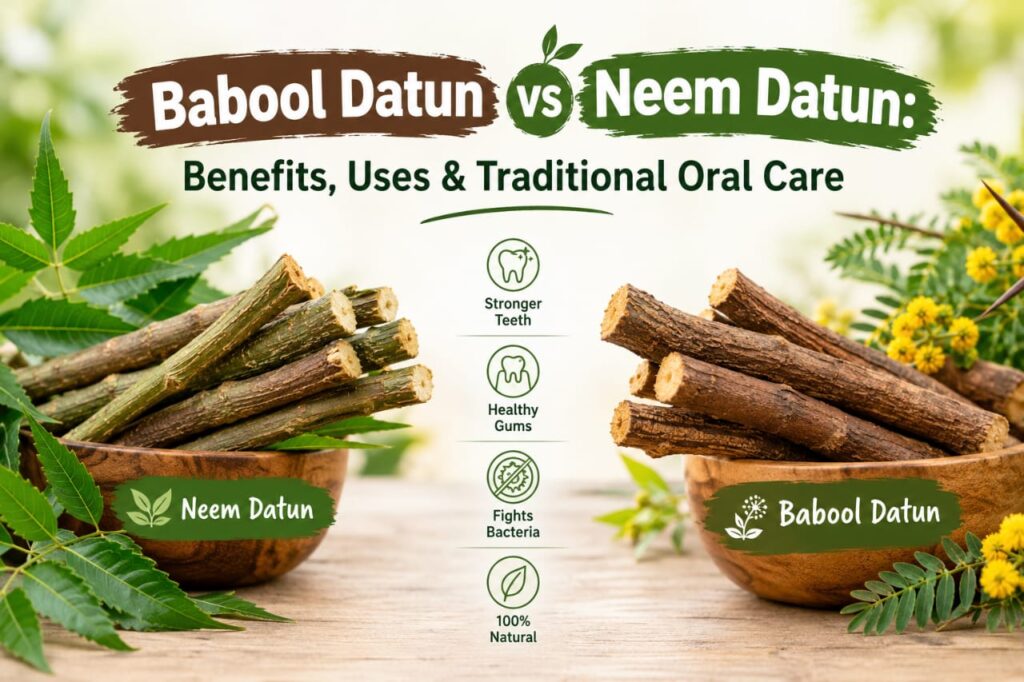
For generations, datun has been a simple and natural way of maintaining oral hygiene in India. Instead of using a conventional toothbrush, people traditionally use a fresh twig from selected trees, chew one end until it becomes fibrous, and gently rub the fibres over the teeth and gums. Among the most familiar choices are Babool Datun and Neem Datun.
Both sticks have a long place in traditional Indian oral care, but they aren’t interchangeable. Babool is known for firmer fibres and a dry, astringent feel. Neem is known for its bitter taste and for plant compounds that have shown antimicrobial activity in lab and oral-care studies. Some studies of neem and babool chewing sticks found activity against Streptococcus mutans, a bacterium linked to tooth decay. Lab results like these don’t show that a datun prevents or treats dental problems, so don’t read them that way.
Knowing how each one is traditionally used makes it easier to pick the one that suits your routine. If you want a firmer, drier feel, try babool. If you don’t mind the bitterness, neem is the more familiar choice.
What Are the Traditional Benefits of Babool Datun?
Babool Datun is traditionally prepared from the twigs of the babool tree, commonly identified with Acacia species. Babool has been used as a chewing stick in India for generations and is among the traditional plant materials used for cleaning the teeth.
One of the main reasons babool datun is preferred traditionally is its firm yet chewable texture. When the end of a suitable twig is softened by chewing, it separates into fine fibres that can mechanically clean the surfaces of the teeth.
Traditional benefits associated with Babool Datun include:
1. Mechanical cleaning of teeth
The softened fibres can help loosen food particles and surface deposits when the stick is used gently across the teeth.
2. Traditional gum care
Babool has traditionally been used as part of routines intended to keep the teeth and gums clean. Its astringent character is also one reason it has a place in traditional oral-care practices.
3. Fresh, simple oral-care routine
A fresh datun does not require toothpaste, a brush handle or additional equipment, making it a straightforward traditional practice.
4. Plant-based oral cleaning
Babool provides a plant-derived alternative to a conventional brushing routine. However, natural does not automatically mean superior, and proper technique remains important.
5. Traditional antimicrobial interest
Research comparing neem and babool chewing-stick extracts has demonstrated antimicrobial activity against Streptococcus mutans in laboratory testing. In that study, neem extract showed greater antimicrobial activity than babool extract under the experimental conditions.
It is important to distinguish traditional use from established medical treatment. Babool datun should be viewed as an oral-hygiene aid rather than a treatment for cavities, gum disease, infections or other dental problems.
How to Use Babool Datun for Daily Teeth Cleaning?
Using a datun correctly is just as important as choosing the plant. Excessive pressure or an unsuitable twig can irritate the gums.
Step-by-step Babool Datun method
Step 1: Choose a fresh twig
Select a clean, fresh and reasonably thin babool twig from a reliable source. Avoid twigs that are mouldy, excessively dry, dirty or damaged.
Step 2: Wash it properly
Rinse the twig thoroughly with clean water before use.
Step 3: Prepare one end
Chew one end gently until the bark and wood become soft and the end develops brush-like fibres.
Step 4: Clean the teeth gently
Use the fibres to clean the front, back and chewing surfaces of the teeth. Gentle vertical or small controlled movements are preferable to aggressive scrubbing.
Step 5: Pay attention to the gumline
The gumline can collect plaque, but it is also sensitive. Use light pressure rather than forcing the fibres into the gums.
Step 6: Rinse the mouth
After cleaning, rinse your mouth with clean water.
Step 7: Discard the used portion
Do not repeatedly use an old, contaminated or excessively frayed stick. Prepare a fresh portion when required.
The traditional cleaning action of chewing sticks is primarily mechanical, although plant compounds may also contribute to their activity. Research on chewing sticks indicates that their effectiveness depends significantly on how they are used and which areas of the mouth are reached.
What Is Neem Datun and How Does It Work?
Neem datun is a chewing stick cut from the twigs of the neem tree (Azadirachta indica). Neem has a special place in Indian tradition, and its twigs were used as natural toothbrushes for generations.
It cleans in two ways. The first is physical. When you chew one end of the twig, it frays into soft fibres that lift food particles and plaque off the teeth. The second is chemical. Compounds released from the plant may act on bacteria in the mouth.
There is some research behind that second point. A laboratory study of neem and babool chewing sticks found activity against Streptococcus mutans, a bacterium linked to tooth decay. Because it was an in-vitro study, done in a lab and not in people’s mouths, it doesn’t show that everyday datun use gives the same result. Other research has looked at neem-based products and their effect on plaque and gum health, but those studies mostly used mouthrinses and formulated products. Their results shouldn’t be assumed to apply to a fresh twig.
The fairest way to describe neem datun is as a traditional, plant-based way to clean the teeth that has some promising lab evidence. It isn’t a cure for dental problems, and it doesn’t replace brushing routines or a dentist’s care.
What Are the Traditional Benefits of Neem Datun?
Neem datun is one of the best-known forms of traditional Indian datun. Its characteristic bitterness and natural plant compounds distinguish it from many other chewing sticks.
Traditional benefits of Neem Datun include:
1. Helps with mechanical cleaning
The fibres created by chewing the twig can help remove food particles and disturb surface plaque.
2. Traditionally associated with gum care
Neem twigs have traditionally been used as part of daily oral-cleaning practices, including cleaning around the teeth and gumline.
3. Natural antimicrobial properties
Laboratory research has found antimicrobial activity from neem chewing-stick extracts against Streptococcus mutans.
4. Supports a traditional oral-care routine
For people interested in traditional Indian practices, neem datun offers a simple way to incorporate a familiar plant-based practice into oral hygiene.
5. Fresh and convenient format
A properly prepared twig can be used without a separate toothbrush or toothpaste.
However, neem’s traditional reputation should not be confused with a medical claim. A datun cannot remove established tartar, repair cavities or replace treatment for gum disease. Persistent bleeding, swelling, tooth pain, sensitivity or loose teeth should be assessed by a dentist.
How to Use Neem Datun for Daily Oral Care?
The basic method is similar to Babool Datun, but neem’s bitter taste can make the experience different.
Step-by-step Neem Datun method
1. Select a clean twig
Choose a fresh, healthy-looking neem twig that is suitable for chewing.
2. Wash before use
Clean the twig under running water to remove visible dirt.
3. Soften the end
Gently chew one end until it separates into fine, brush-like fibres.
4. Brush gently
Move the fibres across the teeth using controlled movements. Clean the outer, inner and chewing surfaces.
5. Clean around the gumline carefully
Do not press the twig aggressively against the gums. Gentle cleaning is sufficient.
6. Rinse after use
Rinse your mouth with clean water once you finish.
7. Dispose of the used twig hygienically
Do not store a wet, used piece for prolonged periods where it can become contaminated.
Recent practical guidance on neem datun similarly recommends using a clean, thin twig, chewing the end to create fibres, cleaning gently, rinsing afterwards and avoiding excessive force.
What Is the Difference Between Babool Datun and Neem Datun?
Both are traditional chewing sticks, but their plant characteristics, taste and traditional uses differ.
| Feature | Babool Datun | Neem Datun |
| Plant source | Babool/Acacia species | Neem (Azadirachta indica) |
| Traditional use | Teeth and gum cleaning | Teeth and gum cleaning |
| Taste | Mild to moderately astringent | Characteristically bitter |
| Cleaning action | Mainly mechanical through softened fibres | Mechanical cleaning plus plant-derived compounds |
| Traditional reputation | Associated with firm fibres and astringent oral care | Widely associated with natural antimicrobial properties |
| Research interest | Studied for antimicrobial activity against oral bacteria | Studied extensively for antimicrobial activity |
| Preparation | Chew one end to form fibres | Chew one end to form fibres |
| Best suited for | People who prefer a milder traditional datun experience | People who prefer neem’s traditional bitter profile |
| Important consideration | Use gentle pressure | Use gentle pressure and avoid keeping neem juice in the mouth for prolonged periods |
| Dental treatment replacement? | No | No |
A laboratory comparison of neem and babool chewing-stick extracts found antimicrobial activity from both, with neem showing significantly higher activity under the study conditions. This does not mean neem is universally better for every person or every oral-health need.
Babool Datun vs Neem Datun: Which Should You Choose?
The choice largely depends on personal preference, availability, traditional practice and proper technique.
If you prefer a traditional datun with a comparatively less bitter profile and firm fibres, Babool may be a comfortable choice. If you specifically prefer neem and its long-standing association with traditional Indian oral care, Neem Datun may suit your routine.
Rather than focusing only on which plant is “stronger,” pay attention to the quality of the twig and how you use it. A datun used aggressively can irritate the gums, while poor technique can leave some tooth surfaces inadequately cleaned.
Modern research on traditional oral-hygiene methods also suggests that chewing sticks can provide meaningful plaque-control benefits when properly used, but the evidence is not uniform for every traditional method or every long-term dental outcome.
Traditional Datun Oral-Care Flowchart
CHOOSE YOUR DATUSN
│
▼
┌─────────────────────┐
│ Babool or Neem Twig │
└──────────┬──────────┘
│
▼
Check the Twig
│
┌──────────┴──────────┐
│ │
Clean & Fresh Dirty/Damaged
│ │
▼ ▼
Rinse Well Do Not Use
│
▼
Soften One End
by Gentle Chewing
│
▼
Create Fine Fibres
│
▼
Gently Clean the Teeth
│
┌──┴───┐
│ │
Teeth Gumline
│ │
└──┬───┘
│
▼
Avoid Hard Scrubbing
│
▼
Rinse Mouth
│
▼
Dispose of Used Twig
│
▼
Continue Regular Oral Hygiene
│
▼
Dental Check-up When Needed
This process highlights an important point: the benefit of datun is not simply in the twig itself. Proper selection, preparation, technique and consistency all matter.
Babool Datun and Neem Datun: What Does Research Say?
Traditional oral hygiene has attracted considerable scientific interest because chewing sticks combine physical cleaning with exposure to plant compounds.
A study comparing neem and babool chewing-stick extracts found antimicrobial activity against Streptococcus mutans, with neem showing greater activity than babool in the tested concentrations. Since this was an in-vitro study, it provides laboratory evidence rather than direct proof of clinical effectiveness in everyday users.
Research on chewing sticks more broadly suggests that their cleaning effect comes partly from the mechanical action of the fibres. Studies have also examined possible chemical and antimicrobial effects.
A study conducted among schoolchildren in Lucknow found that participants using miswak had lower mean gingival-index scores than conventional toothbrush-and-toothpaste users, while the lowest mean plaque score was observed among participants who used both miswak and a toothbrush. This study involved 297 children aged 12–15 years, so its findings should not be generalized automatically to every age group or every type of datun.
More recent systematic-review evidence on traditional oral-hygiene practices has found that some traditional methods can reduce plaque and gingival inflammation, while also noting limitations in the available evidence.
The takeaway is straightforward: datun has a genuine traditional and research-supported role as an oral-hygiene aid, but it should not be marketed as a cure for dental disease.
How to Use Datun Safely
Whether using Babool or Neem Datun, follow a few simple precautions:
- Always choose a clean and fresh twig from a reliable source.
- Wash the twig before use.
- Avoid very hard, sharp or excessively dry pieces.
- Do not scrub the teeth aggressively.
- Be especially gentle around sensitive or bleeding gums.
- Do not share a used datun with another person.
- Avoid storing used, wet twigs for long periods.
- Rinse the mouth after cleaning.
- Replace the twig or prepare a fresh portion regularly.
- Do not use datun as a substitute for professional dental treatment.
Most importantly, natural oral care should complement good dental hygiene rather than replace necessary dental care. Dental professionals can identify cavities, gum disease, tartar and other problems that a datun cannot treat.
Why Choose Traditional Datun from Palleram Organic?
For consumers looking to reconnect with traditional Indian wellness practices, the quality and handling of the product are important. A datun intended for oral use should be clean, appropriately prepared and handled hygienically from sourcing through packaging.
At Palleram Organic, traditional wellness products like Desi khand, Jaggery powder, Organic Jaggery can be approached with an emphasis on natural ingredients and familiar Indian practices. Buy Babool Datun and neem datun represent a simple oral-care tradition that has been passed down through generations.
The goal is not to make exaggerated claims about natural products, but to preserve a traditional practice in a form that is convenient and practical for today’s routines.
Final Takeaway
Babool Datun and Neem Datun online are both traditional plant-based oral-cleaning sticks used for generations in India. Their primary benefit comes from the mechanical action of their fibres, while research has also investigated antimicrobial properties associated with their plant compounds.
Babool is traditionally appreciated for its firm fibres and astringent character, whereas neem is particularly recognised for its bitter taste and antimicrobial research. A laboratory study found antimicrobial activity from both neem and babool extracts, with neem showing greater activity against Streptococcus mutans under the conditions tested.
Neither should be presented as a cure for cavities, gum disease or oral infections. The most important factors are choosing a clean product, using gentle technique and maintaining regular oral hygiene. For anyone experiencing persistent toothache, bleeding gums, swelling, sensitivity or other dental symptoms, professional dental evaluation remains important.
Frequently Asked Questions
1. Is Babool Datun good for daily teeth cleaning?
Babool Datun has traditionally been used for daily oral cleaning. Its softened fibres can mechanically clean tooth surfaces and help remove food particles and surface deposits. Use it gently rather than applying excessive pressure.
2. Is Neem Datun better than Babool Datun?
There is no universal answer that one is better for everyone. Both are traditional chewing sticks, and laboratory research has found antimicrobial activity in extracts of both. Neem showed stronger activity than babool in one laboratory study against Streptococcus mutans, but that does not establish that neem is clinically superior for every person.
3. Can Neem Datun replace a toothbrush?
Neem Datun can be used as a traditional oral-hygiene aid, but it should not automatically be considered a complete replacement for modern dental care. Proper cleaning technique and coverage of all tooth surfaces are important, and dental professionals may recommend fluoride toothpaste and other measures according to individual needs.
4. How often can I use Babool Datun?
Traditionally, datun may be incorporated into a regular oral-care routine. The key consideration is gentle technique rather than aggressive or prolonged rubbing. If your gums become sore, irritated or bleed repeatedly, stop and consult a dental professional.
5. Can Neem Datun help with bad breath?
Cleaning food particles and plaque from the mouth may help maintain oral freshness. Neem’s characteristic bitter taste and plant compounds are also traditionally associated with oral care. However, persistent bad breath can have several causes, including dental and gum problems, and should be professionally assessed if it continues.
6. Does Babool Datun remove dental plaque?
The fibres of a properly prepared chewing stick can mechanically disturb and remove plaque from tooth surfaces. Research on chewing sticks supports their potential role in plaque control, although effectiveness depends on technique and the areas reached.
7. Can children use Neem or Babool Datun?
Children should use any chewing stick only with appropriate supervision and a suitable, clean twig. Because technique and pressure matter, parents should ensure that children do not chew or scrub aggressively. For young children, ask a dentist about the most appropriate oral-hygiene method.
8. Should I visit a dentist if I use datun regularly?
Yes. Datun can be part of a traditional oral-care routine, but it does not replace dental examinations. Regular dental check-ups can identify cavities, tartar, gum disease and other conditions that may not be apparent during everyday cleaning.
Related Blog: Organic Desi Khand: What It Is, Uses, Differences & Buying Guide
Related Blog: Neem Datun vs Babool Datun vs Toothpaste: Which Is Best for Healthy Teeth?