
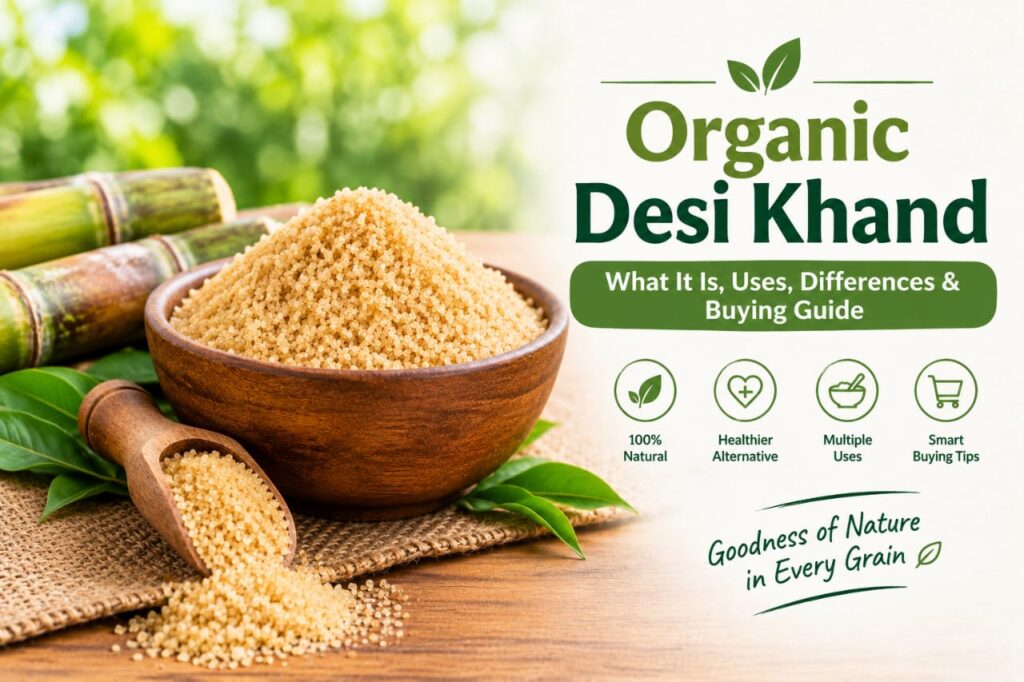
Open almost any Indian kitchen cabinet and you’ll find sugar, but the sugar in the jar isn’t always the same. Desi khand is the older kind, made by boiling sugarcane juice and letting it crystallize, the way it was done long before large refineries. You can usually spot it by its coarse, uneven grains and a pale golden or cream colour. The taste is a little warmer and rounder than plain white sugar, with a faint caramel note that comes from the cane itself.
Organic desi khand is a good pick if you want a more traditional sweetener for chai, sweets and everyday cooking. But what is it, exactly? How does it differ from regular sugar? How is it made, and what should you check before you buy pure organic desi khand online?
This guide answers all of that. It covers how desi khand is made and where it works best in the kitchen, and it ends with a buying checklist you can use before you order.
What Is Desi Khand?
Desi Khand is a traditional form of khandsari sugar made from sugarcane juice. Unlike plantation white sugar, which undergoes extensive industrial refining, khandsari sugar is traditionally produced through an open-pan process.
FSSAI’s food standards specifically recognise Khandsari Sugar Desi as a form of khandsari sugar obtained from sugarcane juice through an open-pan process. It may occur in crystalline or powdered form.
The word “desi” reflects its traditional Indian character, while “khand” generally refers to the crystalline sugar obtained during processing. Depending on the production method and raw material, Desi Khand can have a slightly different colour, aroma, grain size and flavour from refined white sugar.
Desi Khand at a glance
| Feature | Desi Khand |
| Main source | Sugarcane |
| Traditional process | Open-pan processing |
| Form | Crystals or powder |
| Taste | Mild, naturally characteristic sweetness |
| Appearance | Usually off-white to light golden, depending on processing |
| Common uses | Tea, milk, desserts, sweets, cooking and baking |
| Category | Traditional khandsari sugar |
| Best for | People seeking a traditional alternative to highly refined sugar |
It is important to remember that Desi Khand is still a sugar. Its traditional processing does not make it sugar-free or automatically suitable for unlimited consumption.
How Is Desi Khand Made?
Traditional Desi Khand starts with sugarcane juice. The juice is extracted, cleaned and heated to concentrate it. As water evaporates, the concentrated sugarcane juice becomes thicker and begins to form sugar crystals.
The basic process can be understood through this flowchart:
Desi Khand Making Process
Fresh Sugarcane
↓
Sugarcane Juice Extraction
↓
Juice Cleaning & Filtration
↓
Controlled Heating
↓
Concentration of Sugarcane Juice
↓
Crystallisation
↓
Separation & Drying
↓
Sorting and Quality Check
↓
Packing
↓
Desi Khand Ready to Use
The exact processing method can vary between producers. FSSAI standards describe Desi Khandsari Sugar as being obtained from sugarcane juice through an open-pan process.
This traditional approach is one of the reasons Desi Khand is often chosen by consumers who prefer familiar, less industrial-looking ingredients.
Is Desi Khand Better Than Sugar?
The answer depends on what you mean by “better.”
If your priority is traditional processing and flavour, Desi Khand can be an appealing alternative to highly refined white sugar. However, it should not be presented as a sugar-free or universally healthier sweetener.
Both products primarily provide sweetness and carbohydrates. Desi Khand 1kg Price : 199 Rs is still a form of sugar, so portion size matters.
One practical difference is processing. Traditional Desi Khand is made using an open-pan khandsari process, while refined white sugar goes through additional purification and crystallisation steps.
Desi Khand vs White Sugar
| Comparison | Desi Khand | Refined White Sugar |
| Source | Sugarcane | Sugarcane or sugar beet, depending on market |
| Processing | Traditional khandsari/open-pan process | More extensive industrial refining |
| Appearance | Often off-white/light golden | White |
| Texture | Grainy/crystalline | Uniform crystals |
| Flavour | More characteristic sugarcane-like notes | Neutral sweetness |
| Traditional use | Common in traditional foods and beverages | Widely used in modern cooking and food manufacturing |
| Sugar content | High | High |
| Sugar-free? | No | No |
So, if you are asking “Is Desi Khand healthier simply because it is traditional?”, the answer is not necessarily. If you are asking “Is it a traditional alternative to refined white sugar?”, that is a more accurate description.
Traditional Desi Khand and Organic Desi Khand: What’s the Difference?
“Traditional” and “organic” describe different things.
Traditional Desi Khand refers primarily to the style or nature of the product and its traditional processing.
Organic Desi Khand refers to a product that is produced and labelled according to applicable organic production standards.
In India, FSSAI regulates organic foods under the Food Safety and Standards (Organic Foods) Regulations, 2017. The recognised certification systems include NPOP and PGS-India.
Therefore, consumers looking for pure organic Desi Khand online should not rely only on words such as “natural,” “traditional” or “chemical-free.” They should check the product’s certification and label details.
For certified organic products, the Jaivik Bharat consumer guidance recommends checking details such as the FSSAI logo and licence number, applicable organic logo/certification information and certification-body details.
What Does “Chemical-Free Desi Khand” Mean?
“Chemical-free” is a term consumers frequently use when looking for minimally processed or naturally produced foods. However, it should not be treated as a blanket scientific claim.
A better approach is to look at how the product is produced, what ingredients are listed, what processing methods are used and whether the organic claim is properly certified where applicable.
FSSAI describes organic food production as focusing on practices including biodiversity, soil health and chemical-free inputs while requiring production according to organic standards.
For Palleram Organic customers, the most useful buying habit is therefore simple: read the label, check the ingredients and verify the relevant certification or product information rather than relying on a marketing phrase alone.
How to Use Desi Khand
One of the biggest advantages of Desi Khand is that it can be incorporated into many of the same everyday foods in which people normally use sugar.
Its crystalline texture makes it convenient for beverages, desserts and cooking.
Here are some common ways to use it.
Desi Khand for Tea
Desi Khand can be used to sweeten everyday tea.
Add it gradually while the tea is hot and stir until the crystals dissolve. Because its flavour may be slightly more characteristic than refined white sugar, it can work particularly well in milk tea, masala chai and other traditional beverages.
Simple tip: Start with a smaller quantity and adjust according to taste. The sweetness level you need will depend on the recipe and your personal preference.
Desi Khand for Sweets
Desi Khand can also be used in Indian sweets and homemade desserts.
It can be suitable for recipes such as:
- Kheer
- Halwa
- Homemade laddoos
- Porridge
- Sweetened milk
- Traditional desserts
- Homemade biscuits and baked foods
- Pancakes and other breakfast recipes
For recipes where sugar needs to dissolve completely, it can help to dissolve Desi Khand in a liquid ingredient first or use a suitably fine form.
Desi Khand in Everyday Cooking
Beyond tea and sweets, Desi Khand can be used wherever a recipe calls for a sweetening ingredient.
It can be added to homemade drinks, breakfast preparations and selected sauces or marinades. The key is to remember that Desi Khand has its own taste and texture, so the final result may differ slightly from one made with refined white sugar.
Why Choose Organic Desi Khand?
For consumers who prefer traditional food ingredients, organic Desi Khand can bring together two preferences: a traditional sweetener and an organic production approach.
The reasons someone may choose it include:
- Traditional character: Desi Khand is associated with traditional khandsari sugar production rather than highly refined white sugar.
- Distinctive taste: Its flavour can offer a different experience from neutral-tasting refined sugar.
- Versatile use: It can be used in tea, milk, Indian sweets, desserts and everyday recipes.
- Simple ingredient choice: Consumers can use it as a straightforward sweetening ingredient in homemade food.
- Organic preference: Where properly certified, organic Desi Khand can suit consumers specifically seeking certified organic food products.
However, choosing an organic sweetener does not remove the need to consume sugar in moderation.
How to Choose Pure Organic Desi Khand Online
Buying food online is convenient, but the product description should not be the only thing you consider.
Before ordering pure organic Desi Khand online, check the following:
1. Check the ingredient list
Look for a clear and straightforward ingredient declaration. Avoid making assumptions based solely on terms such as “natural” or “traditional.”
2. Check organic certification
If a product is marketed as organic, look for the relevant certification information. FSSAI’s organic-food framework recognises NPOP and PGS-India certification systems.
3. Check the FSSAI details
A packaged food product should provide the relevant food business information, including the FSSAI licence details where applicable.
4. Look at the packaging
Choose properly sealed packaging that protects the product from moisture, contamination and handling during storage and delivery.
5. Check the product description
The product page should clearly explain the product type, ingredients, quantity, storage instructions and other relevant information.
6. Don’t confuse organic with sugar-free
Organic Desi Khand is still sugar. Organic certification describes how the product is produced and certified; it does not mean the product contains no sugar.
7. Buy from a transparent seller
A trustworthy seller should provide clear product information rather than relying entirely on broad claims such as “healthy,” “chemical-free” or “100% pure.”
Why Palleram Organic Desi Khand?
When choosing a traditional sweetener for your kitchen, the quality of the ingredient and transparency of its sourcing and processing matter.
Palleram Organic focuses on bringing traditional food choices closer to modern households, making it easier for consumers to explore familiar Indian ingredients through a convenient online buying experience.
If you are looking for traditional Desi Khand for your daily tea, homemade sweets or cooking, choose a product whose ingredient information, packaging and applicable organic credentials are clearly presented.
Instead of treating Desi Khand as a “healthy sugar,” think of it as a traditional sugar option that can fit naturally into everyday recipes.
Where to Buy Desi Khand Online?
You can buy Desi Khand online without visiting multiple stores. However, before placing your order, compare the product information carefully.
If you are specifically searching for pure organic Desi Khand online, look for:
- Clear ingredient information
- Appropriate organic certification details
- FSSAI information
- Secure packaging
- Product quantity and pricing
- Storage instructions
- Seller information
- Transparent product descriptions
For consumers who already prefer organic pantry staples, buying online can make it easier to keep products such as Desi Khand available for everyday use.
Desi Khand: Quick Buying Checklist
Looking for Desi Khand?
↓
Do you want traditional khandsari sugar?
↓
Check the ingredient list
↓
Is it marketed as organic?
↓
Verify the applicable organic certification/details
↓
Check FSSAI information
↓
Review packaging, quantity and storage instructions
↓
Compare seller and product information
↓
Choose the product that matches your requirements
This simple process can help you make a more informed choice instead of choosing a product only because its packaging says “natural” or “chemical-free.”
Final Thoughts
Desi khand is a simple sweetener made from sugarcane, and that’s most of its appeal. The crystals are coarse, the colour is a little golden, and the flavour has a softness that bleached white sugar doesn’t. It’s also the sweetener many Indian kitchens used before refined sugar became the default. It works in a cup of chai, a bowl of halwa or a pot of kheer.
When you shop for the organic kind, read past the front of the pack. Check the ingredient list, the packaging, the FSSAI number and the organic certification. Two things are worth remembering: organic doesn’t mean sugar-free, and a traditional method doesn’t automatically make something healthier. It’s still sugar, so keep portions sensible.
If you like traditional ingredients and prefer to order online, Palleram Organic Desi Khand is one option to consider for your pantry. It could go into your morning tea, homemade mithai or whatever you’re cooking this festive season also provide Desi Gur. Compare the label details with other brands before you decide, as you would with any food product.
Frequently Asked Questions About Desi Khand
1. What is Desi Khand?
Desi Khand is a traditional form of khandsari sugar made from sugarcane juice. FSSAI recognises Khandsari Sugar Desi as a sugar obtained from sugarcane juice through an open-pan process.
2. Is Desi Khand better than white sugar?
Desi Khand can be preferred by people looking for a traditional alternative to refined white sugar, particularly for its processing style and characteristic flavour. However, it is still sugar and should not be considered sugar-free or automatically healthier.
3. How is Desi Khand made?
Traditional Desi Khand is produced from sugarcane juice through processes involving juice extraction, cleaning, concentration, crystallisation and drying. FSSAI describes Desi Khandsari Sugar as being obtained through an open-pan process.
4. Can I use Desi Khand for tea?
Yes. Desi Khand can be used as a sweetener in tea. Add it according to your preferred level of sweetness and allow the crystals to dissolve properly.
5. Can Desi Khand be used for making sweets?
Yes. Desi Khand can be used in several homemade sweets and desserts, including kheer, halwa and laddoos. Depending on the recipe, you may need to adjust the quantity or dissolve it before adding it.
6. Is organic Desi Khand chemical-free?
The term “chemical-free” should be interpreted carefully. If a product is sold as organic, check that it meets applicable organic standards and has the relevant certification or labelling information. FSSAI regulates organic foods under the Food Safety and Standards (Organic Foods) Regulations, 2017.
7. Where can I buy pure organic Desi Khand online?
You can buy it online from a seller that provides clear information about ingredients, product quantity, packaging, FSSAI details and applicable organic certification. If you are specifically looking for certified organic food, verify the certification information before purchasing.
8. Is traditional Desi Khand the same as jaggery?
No. Although both are traditional sugarcane-derived sweeteners, they are different products. Jaggery is generally produced by concentrating sugarcane juice into a solid or semi-solid sweetener, while Desi Khand is a crystalline form of khandsari sugar produced through a crystallisation process.
Related Topics: Top 11 Benefits of Sulphur-Free Desi Khand
Related Topics: Which Sugar Is Healthiest in India? Types, Benefits & Best Choice for You